
The W-shaped company: built to change course
A working map for connecting opportunity, evidence, capital, and execution as people and AI agents build a business together.
This morning, over coffee, I read How Companies Can Compete in an AI-Native World, written by Alison E. Berman with insights from Jody Medich. The part I kept coming back to was the company itself: how it’s built, who makes decisions, and how knowledge travels. Read the Singularity report.
An established business has to fit AI into an organization that already exists. A new business can design the work around people and agents from day one. That opens up a much bigger conversation about what a company could become.
Imagine a small brand with a product that sells on one marketplace. The owner wants to reach another market. There’s a budget, some encouraging demand data, and a team already busy keeping the existing business running.
An agent can research the opportunity. Another can prepare listings. Someone can generate a launch plan before lunch.
The owner still needs to decide whether this is a good use of the company’s money. And if the answer is yes, the business has to deliver: secure the stock, reach customers, handle orders, and notice when the plan stops making sense.
That whole journey is what interests me. A company that can carry an idea into the world, see what happens, and change course with the evidence still attached.
The idea in 20 seconds
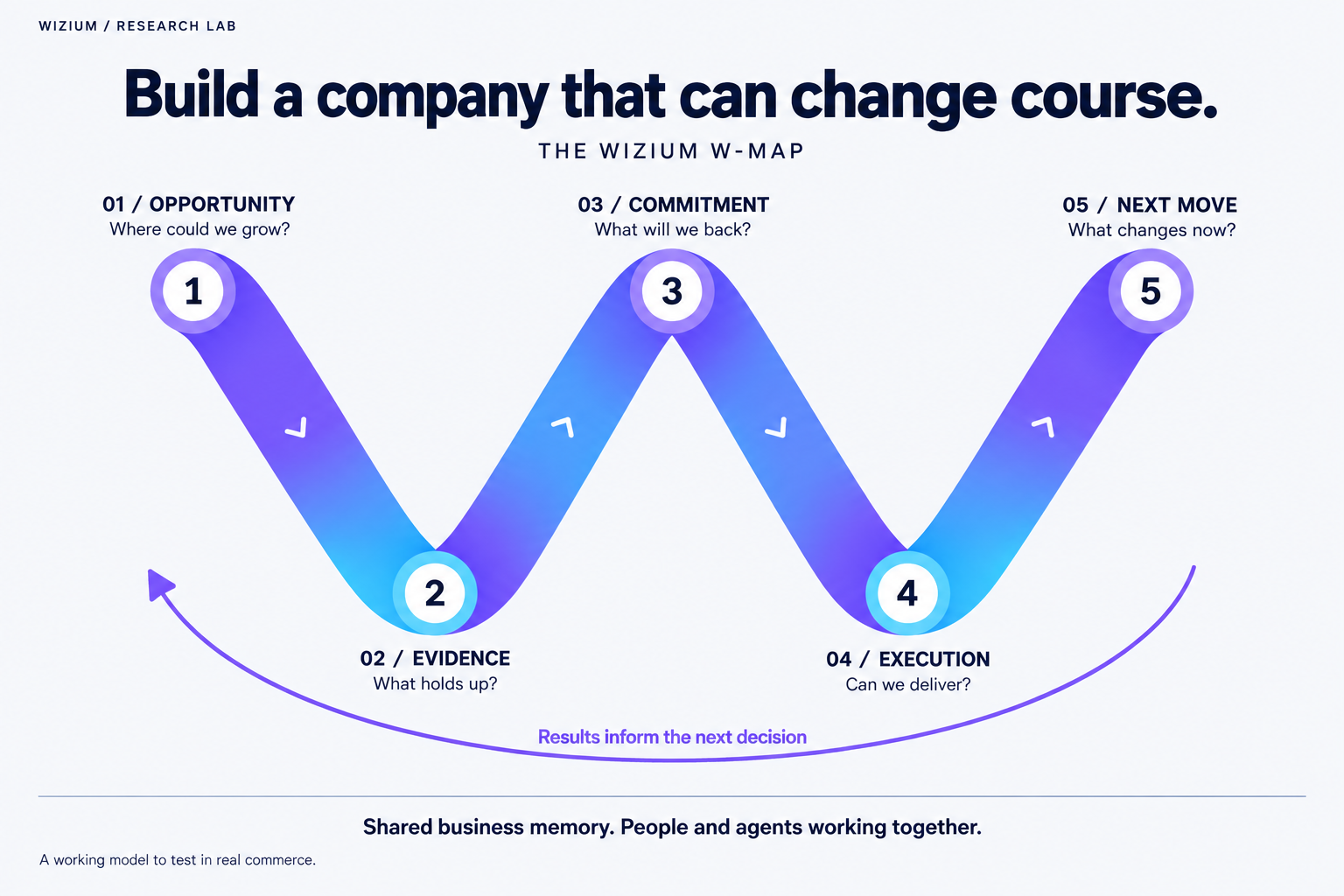
We’re proposing a W-shaped company as a way to think about an agentic commerce business. Its people and agents connect five parts of the work:
Opportunity → Evidence → Commitment → Execution → Next move.
The W is a working map for following a real business decision. We want to test where it helps, where it breaks down, and what a company needs to make those connections work.
A company designed to try something different
In How Companies Can Compete in an AI-Native World, Alison E. Berman develops insights from Jody Medich about a familiar problem: the structures that help an established business perform can also make it difficult to explore a different business model. A young experiment may be judged by the revenue expectations of a mature product, or lose its room to operate as it passes through existing approval processes. Read the full white paper.
For commerce, that raises a useful possibility. A business could test a new channel with a defined budget, an owner, and evidence it needs to gather before the next commitment. It could draw on existing product knowledge and specialist expertise while giving the experiment its own expectations.
The existing business keeps serving customers. The experiment gets enough room to reveal whether a different route is worth pursuing.
For a founder starting fresh, that operating capability could be available from the beginning. This is part of the ambition behind WIZIUM: a birthplace for agentic commerce companies.
What the W represents
The report’s T-shaped and Z-shaped profiles gave me a way into this idea.
A T-shaped person knows one field deeply and can work across disciplines. Think of a sourcing specialist who understands manufacturing inside out and can work through a product decision with finance, marketing, and logistics. IDEO also describes this combination of depth and collaboration. IDEO on creative teams.
A Z-shaped person, as described in the report, connects knowledge across fields and translates between them. They can see how a change in the product affects the offer, the supply chain, and the money needed to deliver it.
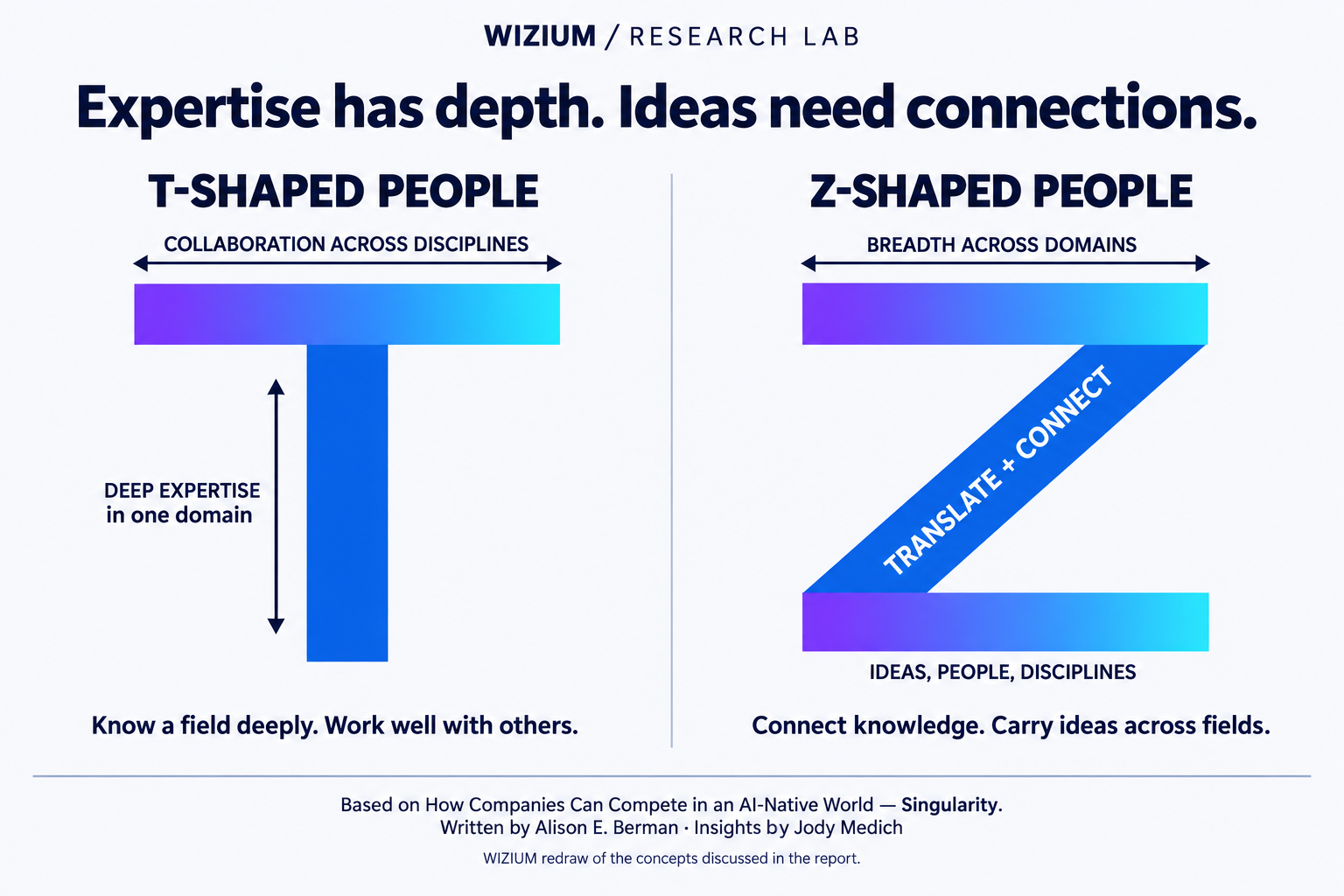
Those are profiles of people. For WIZIUM, I wanted to draw the company they could build together—with agents, shared memory, and the ability to carry an idea through to a working business.
Our W applies at the level of the company. It connects deep investigation with practical execution, with a decision about resources between them. Results then shape the next move.
| Part of the W | What becomes concrete |
|---|---|
| 01 / Opportunity | The customer need, the product or channel worth exploring, and what the business hopes to achieve. |
| 02 / Evidence | Current demand signals, costs, constraints, and competing explanations. Sources and unknowns remain visible. |
| 03 / Commitment | The option being backed, the budget and limits, the person who can authorize it, and what would cause a rethink. |
| 04 / Execution | The work people and agents must complete, including physical operations, dependencies, and customer commitments. |
| 05 / Next move | What actually happened, which assumptions held, and whether to continue, adjust, expand, or stop. |
The two downward strokes represent depth: understanding the opportunity and doing the work. The upward strokes bring that experience back into decisions. The height of the line carries no numerical meaning.
This is WIZIUM’s proposed editorial map, offered for testing in commerce. W-shaped metaphors already exist in other contexts, including descriptions of individual skills. We’re using the shape to make the connections within a company easier to inspect. An earlier use of W-shaped skills.
One product, a second channel, a real decision
Return to the brand considering another market. This is an illustrative scenario, not a customer case.
At Opportunity, the owner names the job: explore a second channel for a particular product while keeping the existing business supplied.
At Evidence, the team compares the economics of each channel. It records fulfillment and acquisition assumptions, stock requirements, and the cost of supporting customers. An unknown stays an unknown. A promising demand estimate doesn’t silently become a sales forecast.
At Commitment, the owner might authorize a bounded test, ask for more evidence, or put the idea aside. If a test goes ahead, the team records the budget, the review point, and the conditions that would make further spending unacceptable. The appropriate thresholds belong to that business.
At Execution, people and agents work from the same decision. A new cost estimate or supply problem can be connected to the plan it affects. The business can check whether its offer and delivery promises still hold.
Say the supplier raises the minimum order just as the second channel is ready to launch. The product may still have demand. But more cash would now sit in stock, leaving less to replenish the channel that already pays the bills.
The owner needs a few workable options: negotiate a smaller batch, narrow the launch, delay it, or walk away. For each, show the cash tied up, the likely effect on margin, the delivery constraints, and the assumptions that could change the answer. Keep the supplier’s update linked to the calculation. That’s a useful response to new information.
At Next move, actual results return to the original assumptions. Perhaps demand is encouraging but customer acquisition leaves too little room. Perhaps the product needs adapting. Perhaps the channel deserves more investment. The team has a basis for the next commitment.
The useful output is a decision the business can act on and revisit as conditions change.
The human role changes with the company
By the time an owner has read every market update, supplier message, and internal discussion, some of it will already be out of date. Adding agents can produce even more information to review.
The company needs a way to turn that flow into a manageable set of decisions. What changed? Which commitment does it affect? What are the workable options? A shared memory could keep the sources and reasoning close enough for a person to challenge the recommendation.
This also gives people different work to grow into: setting direction, questioning assumptions, negotiating, designing products, and deciding which commitments the business is prepared to make. Specialists remain essential to methods, exceptions, and the physical work behind an order.
Nick Jennings adds another consideration in his essay on artificial societies: agents may have different owners and objectives. Individually sensible actions can combine into a result nobody wanted. The behavior of the group matters. Loughborough University’s publication of Jennings’s argument.
For a commerce company, our practical reading is that shared context needs clear decision rights. An agent preparing a recommendation, a person approving expenditure, and a partner confirming delivery have different roles. The working system must preserve those distinctions.
Expertise becomes something the company can keep using
An experienced operator knows which attractive product ideas fall apart under real conditions. Some of that knowledge can become reusable instructions, calculations, and checks. Anthropic’s Agent Skills approach gives one concrete example of packaging expertise this way, with evaluation and iteration built into the authoring process. Anthropic on Agent Skills.
A company would still need to test whether a method fits its situation. A technique that worked for one product or channel may fail elsewhere. Keeping the method current is part of the work.
Our infrastructure hypothesis is that businesses could share access to maintained methods while retaining their own private context. Reusing the common parts could make capabilities more affordable. That advantage would have to survive the real costs of integration, review, and ongoing maintenance.
Capital belongs in the same picture
Expansion, inventory, and product development compete for money. A useful operating record would connect those decisions with their assumptions and results, so the next commitment can be assessed in context.
Over time, such a record could also help a business explain itself to a financing partner. The longer-term WIZIUM vision includes AI-assisted financing and Capital-as-a-Service: connecting capital with commercial opportunities and the people and agents able to execute them. That’s a direction we want to explore as the operating foundation develops.
Put one pending decision on the W
Start with a decision the team already has to make: enter a channel, replenish a product, change an offer, or stop a weak line. Put it on one page using these five prompts:
- Opportunity: What are we considering, and for whom?
- Evidence: What supports it, and what could overturn the case?
- Commitment: What are we authorizing now, within which limits?
- Execution: Who acts next, and what must be true for the work to finish?
- Next move: Which result or change will bring this decision back for review?
Mark the first place where the team has to reconstruct context, guess at authority, or wait for information nobody owns. That is a concrete place to improve the operating system of the business. AI may help there; so may a clearer responsibility or a better connection to an existing tool.
That’s the kind of company we want to help people build in WIZIUM. Some could begin there. Others could bring an existing business and develop the capability to keep adapting it.
For the Research Lab, the next step is to test this map against real decisions. Bring one that changed after work had already begun. We want to understand how the change reached the people doing the work, what was lost along the way, and what helped.